Recommendations Are Tough, Commercialization Is Harder
I started out at TikTok on the data infrastructure / recommendations side — but recently, I switched to a team that works closer to the product itself. In this process, I realized that there’s a hurdle for every new social media platform that people don’t usually talk about: monetization in the new era of data privacy.
No new social media platforms?
Each social media platform makes the same promise of engagement and connection to its users. And each platform effectively handles this the same way — by building capabilities for analyzing the root cause of user actions (a purchase, a like, a share, etc.) This is the ‘data flywheel’ that every successful platform achieves at scale.
While the approach still holds true, TikTok (which launched in 2016!) was the last social media titan — despite numerous companies beating the cold start problem (e.g. Clubhouse, BeReal, etc.) to reach scale (i.e. millions of users). The straightforward (and accurate) answer usually involves some combination of poor product development (BeReal), sub-optimal user composition (Clubhouse), or monetization uncertainty (monetizing consumer apps is so 2010).
The more complicated answer involves ads and data privacy. Let’s examine Meta and Google to illustrate the point:
Big Meta is always watching (kinda)
Meta is known for their use of web trackers across e-commerce and the internet in general.1 As those data tracking efforts became more aggressive, Meta continued to remain opaque in their monetization strategy.2 Companies that don’t rely on ads as their primary revenue source like Mozilla3 and Apple4 took advantage of this and implemented counter-surveillance measures (e.g. Apple’s “do not track” feature) that decimated Meta’s ability to effectively collect information on users.
The data privacy changes broke the user behavior chain for all social media companies. While incumbents like Meta already possessed vast amounts of data on user behavior, which they could use to train models to boost ad revenue through other means, newcomers have been ill-equipped to deal with the challenge. New consumer apps have an incredibly difficult time maintaining state on user activity / journeys, such as:
- User views an ad on Instagram — first-party
- User looks up the product in a web browser — third-party (gone!)
- User makes (or doesn’t make) a purchase decision — third-party (gone!)
- Product website reports back to Instagram — first-party
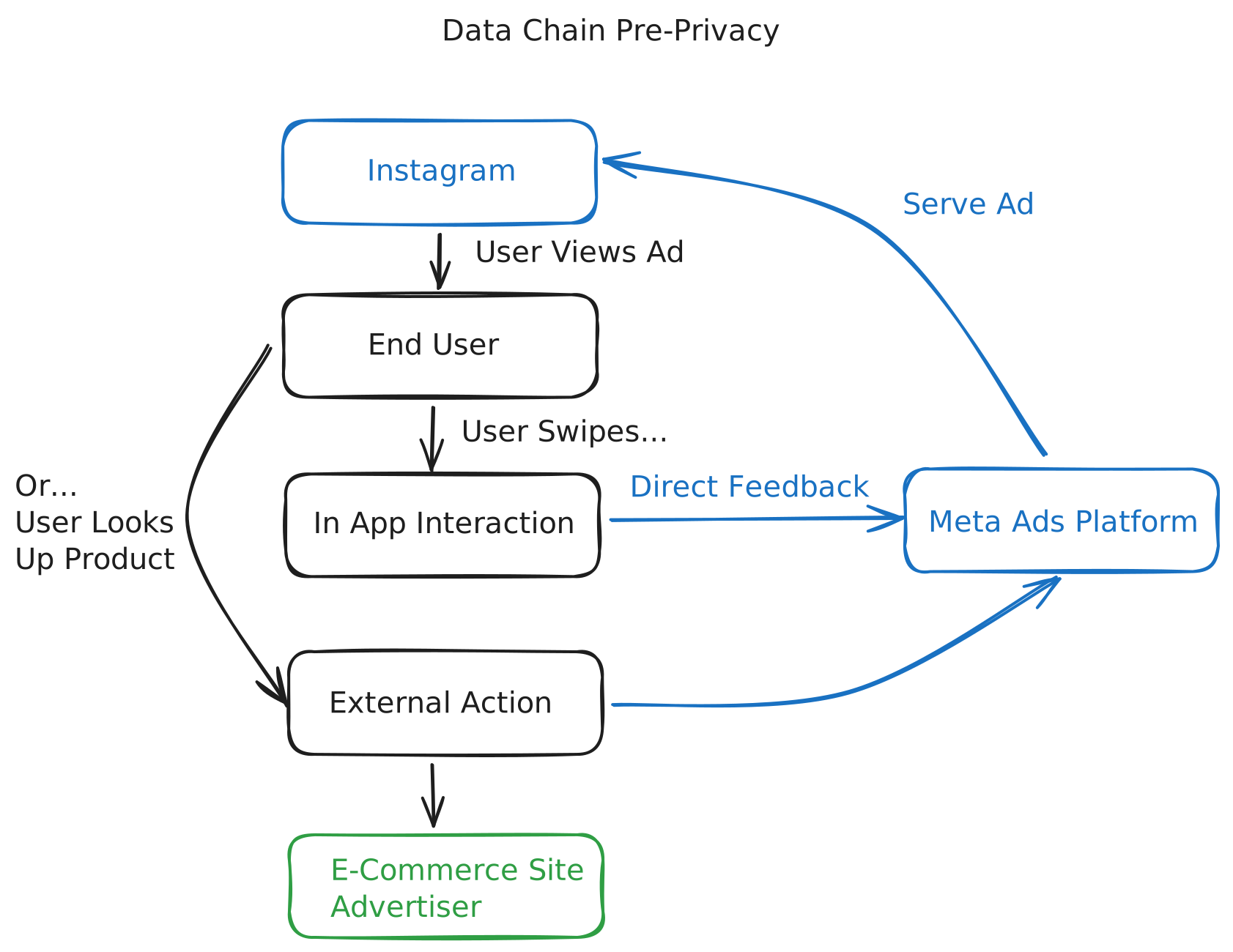
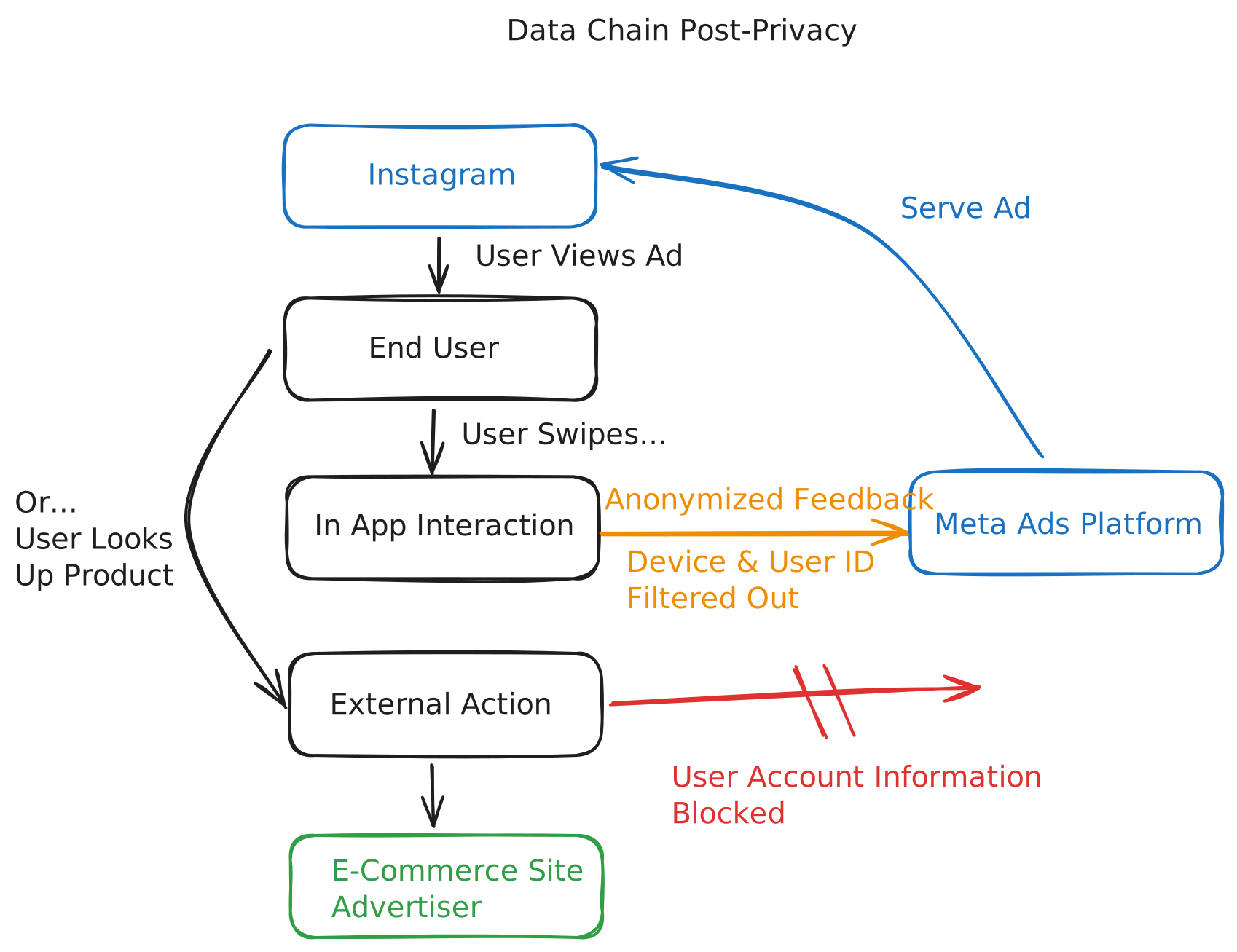
This chain is the most significant data point for training and monitoring e-commerce recommendation pipelines. New consumer applications need to own the end-to-end user purchase lifecycle (i.e. discovery → transaction) in order to have attribution data. However, it’s often easier to achieve initial growth with a wedge product that either lacks monetization and/or ownership over the full transaction lifecycle — and moving from wedge to end-to-end is very difficult.
Google’s platform-up approach
In comparison, Google’s approach is far more stable than Meta’s due to Chrome. Chrome allows Google to:
- Shape the way users interact with the web
- Aggregate information on users (i.e. measure efficacy of Google ads)
- Incorporate user feedback into PageRank (i.e. self-sustaining the loop)
Chrome is the de facto web browser today5, with over half the world’s internet users using it as their default web browser. This makes it far easier for Google to track and conduct root-cause analysis on purchasing behavior compared to both other social media incumbents as well as the consumer startups.
Many of the features in Chrome can be summed up as “more for me, less for thee” — options like enhanced website protection and better ad privacy are meant to protect users from other companies — but in the process, users implicitly consent to handing over every single interaction on the web to Google for pre-vetting on safety. The user actions in Chrome are also directly used to boost search ranking, with direct evidence suggesting this via the Google search feature leak.6
Interestingly enough, a Google antitrust docket thread revealed their intent to collect massive amounts of user data to dominate the ad space.
All hail the ads team
What does all this mean? Unless designed otherwise, every social media platform is an ads business (“if you’re not paying for the product, you are the product”) and their valuation is heavily dependent on the efficiency of translating their user base into a steady stream of revenue — you are either watching ads, or paying to avoid them. Mainstream platforms have tried to branch off, but these ventures are largely unsuccessful. 7 8 9 10 Engineering teams in a social media organization, from ML to infrastructure to mobile, in one way or another work for the ads team. Every decision is aimed at improving user behavior prediction, enhancing user retention, and driving user conversion (paid, sales, etc.), all in service of the platform’s advertising goals.
As companies attribute increased user retention solely as the outcome of their optimizations, the end user is disregarded as an active participating partner, and seen purely as a commodity.
You don’t have to just be the product
Existing business models inherently have misaligned incentives between users and companies, and mistrust from consumers actually makes everyone worse off — there has to be a better way.
In the past, some social media platforms attempted to implement revenue sharing models with their users. However, these efforts often resulted in an influx of artificial or low-quality content as users were incentivized to produce quantity over quality. This content spamming ultimately contributed to the decline of these platforms.11 At the time, effective content moderation and accurate reward/punishment systems at scale were challenging to implement as advancements in NLP were not nearily as advanced as today (BERT came out 2 whole years after the shutdown of Tsu!). Today, new technologies potentially enable this model to work more effectively. Revenue sharing shouldn’t be a coldstart solution, but rather a side product implemented to gain user trust. Additionally, companies could enhance transparency by allowing users to view their ad history and understand the reasons behind specific ad targeting. This combination of approaches allows social media companies to:
- Regain trust through better data transparency
- Improve intent pipelines through direct user involvement
- Boost retention by adding a monetary incentive behind user engagement
The incentive structure for social media platforms has been fundamentally broken from the start. The status quo model will eventually break down as data privacy measures become even more stringent, and consumer sentiments towards social media continue worsening — the lack of new major social media players is just the leading indicator. The answer is actually pretty straightforward: figure out a way to work with users, not against them.